Layer 2 Network Topology
Architecture Overview
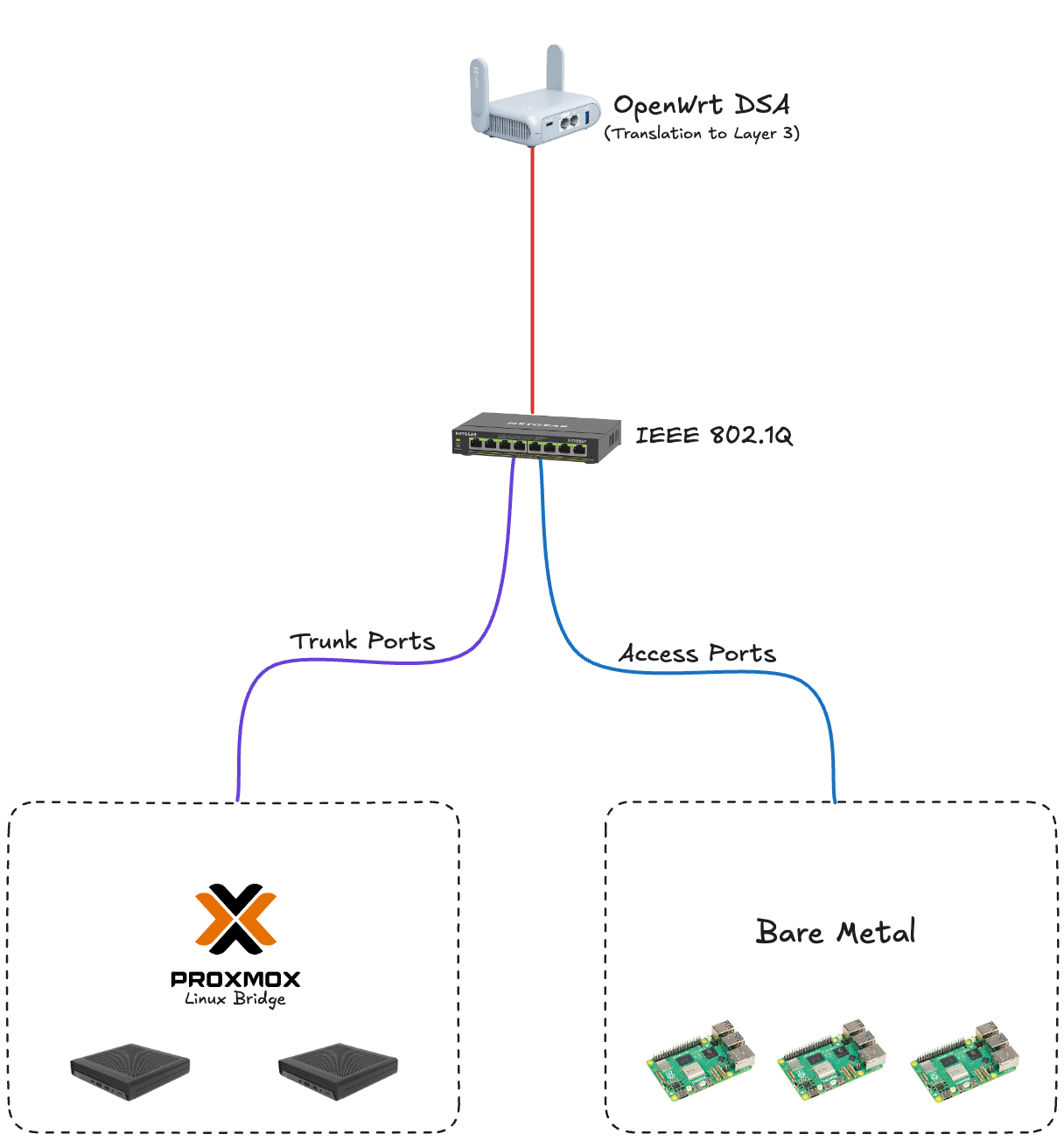
Core Components & Architectural Rationale
1. Hardware L2 Fabric (Netgear GS308EP)
- Role: Serves as the physical IEEE 802.1Q boundary and primary distribution layer.
- Access Ports (Blue): Connects the Bare Metal nodes (Raspberry Pi 5 Control Plane) to enforce strict, hardware-level VLAN assignment.
- Trunk Ports (Purple/Red): Forwards tagged 802.1Q frames to the Proxmox hypervisor nodes and the OpenWrt edge router.
2. Virtual Hypervisor Switch (Proxmox)
- Technology: Native VLAN-aware Linux Bridge (
vmbr0). - Rationale (OVS Deprecation): Open vSwitch (OVS) and SPAN (Port Mirroring) were explicitly excluded from the design to maintain strict isolation for the Offensive Security Enclave (Kali VM - VLAN 40).
- Defense-in-Depth: Utilizing the native Linux Bridge allows the built-in Proxmox firewall to remain fully active on the Kali VM's vNIC, establishing a zero-trust boundary before traffic reaches the physical network.
3. Edge Gateway (OpenWrt - GL-MT3000)
- Technology: Distributed Switch Architecture (DSA).
- Role: Functions as the Layer 2 to Layer 3 translation boundary.
- Rationale: The router natively ingests the L2 trunk and maps the VLANs into logical, isolated Linux interfaces (e.g.,
br-lan.20,br-lan.40). This enables immediate, granular Layer 3 routing and the enforcement of strict Zone-to-Zone firewall policies.